
Digital marketing for real-estate agents is all about using online channels—think social media, Google, and email—to connect with clients, build your brand, and keep leads flowing in. It's the modern way to move past old-school methods like yard signs and start meeting buyers and sellers where they already spend their time: online.
This isn't just about getting a few extra leads here and there. It's about building a predictable system for attracting clients so you're not just waiting for the phone to ring with the next referral.
Why Digital Marketing Is No Longer Optional for Real Estate

The days of relying solely on postcard mailers and newspaper ads are long gone. Today, the journey to buying a home almost always starts with a Google search, not a casual Sunday drive through a neighborhood.
This is a huge shift. It means having a strong online presence isn't just a "nice-to-have" anymore—it’s the absolute core of a successful, modern real estate business.
Think of it this way: you're not just an agent anymore. You're building your own little media company. Your goal is to become the trusted local resource, the go-to expert that people follow long before they’re even thinking about making a move.
Building a Predictable Business
Top agents don't just rely on luck or word-of-mouth. They use digital marketing to build a reliable, consistent stream of leads. They build systems that are out there working for them 24/7, nurturing potential clients and keeping them top-of-mind.
To really nail this, you need a solid game plan. A great starting point is exploring a modern playbook for real estate agent lead generation to see how the pieces fit together.
A powerful digital strategy allows you to build an unshakeable brand, create a consistent pipeline of leads, and nurture client relationships at scale—all before you ever meet in person.
The numbers back this up. For 2026, agents are doubling down on digital. 28% are focused on selling more homes through these channels, 19% want to increase referrals, and 14% are working on generating more high-quality leads. It's a clear signal that the industry is moving online to get measurable results.
Gaining Your Competitive Edge
A sharp digital marketing strategy is your ultimate advantage. It lets you show off your expertise, connect with your community, and prove your value in ways that a billboard or flyer simply can't.
So, what are the biggest wins for today's agent?
- Build Authority and Trust: When you share valuable content like neighborhood guides, market updates, or tips for first-time buyers, you stop being just another salesperson. You become the local expert.
- Reach Hyper-Targeted Audiences: Platforms like Facebook Ads and Google Ads let you get incredibly specific. You can target first-time homebuyers in a particular zip code, empty-nesters looking to downsize, or even people who have recently shown interest in moving.
- Nurture Leads Automatically: With email automation, you can stay in touch with hundreds of prospects at once. You can deliver timely, relevant information that guides them closer to a decision without you having to manually send every single message.
When you master digital marketing, you take control of your own story. You build direct relationships with your audience and create a business that's more resilient, profitable, and frankly, a lot more predictable.
The Modern Agent's Digital Marketing Toolkit
To get a clearer picture, let's break down the core channels every agent should be thinking about. Each one plays a different role, but together they create a powerful system for attracting and converting clients.
Think of these as the essential tools in your belt. You might not use every single one for every listing, but knowing how and when to deploy them is what separates the top producers from everyone else.
Building Your Digital Storefront with Local SEO
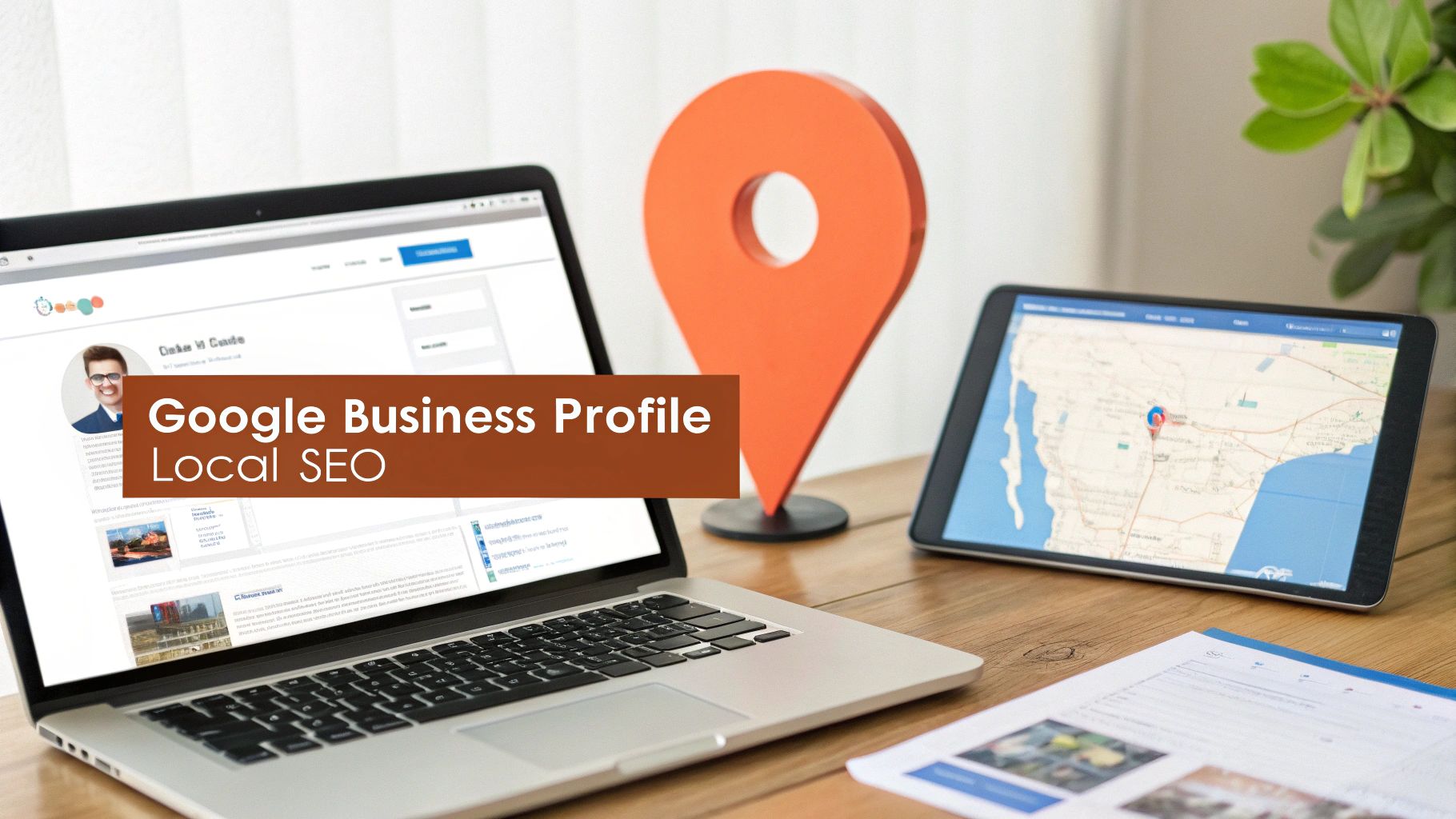
Think of your website as your digital office, open 24/7 to welcome potential clients. But a great office is useless if nobody can find it on the map. That’s exactly what Local Search Engine Optimization (SEO) does—it’s the giant, flashing sign that guides ideal clients straight to your virtual door right when they need you.
Many agents hear "SEO" and immediately think of some complex, technical headache. In reality, it's one of the most powerful and cost-effective tools you have. It's all about making sure you show up when someone in your area types "realtor near me" or "best real estate agent in [Your City]" into Google.
This isn’t about tricking search engines. It's about proving to them that you are the most relevant, authoritative answer to a potential client’s question. When you get it right, local SEO turns your website into a magnet for high-intent buyers and sellers in your specific service areas.
Mastering Your Google Business Profile
Your Google Business Profile (GBP) is the absolute cornerstone of your local SEO strategy. It's that info box that pops up in Google Maps and on the right side of the search results, showing your name, reviews, photos, and contact info. Optimizing it is completely non-negotiable.
A complete and active profile tells Google that you're a legitimate, active business worthy of being shown to people searching for your services. It’s often the very first impression a potential client will have of your brand.
Here’s how to turn it into a lead-generation machine:
- Complete Every Section: Fill out every single field available. Include your service areas, hours, and a detailed business description packed with local keywords.
- Upload High-Quality Photos: Add a professional headshot, team photos, pictures of your office, and images from your community. Aim for at least 10-15 great photos to get started.
- Encourage Reviews: Actively ask every happy client to leave a review. Positive reviews are a massive ranking factor and build incredible social proof.
- Use Google Posts: Regularly share updates, new listings, blog posts, and open house announcements using the Google Posts feature. It shows you’re active and engaged.
Think of your Google Business Profile as a mini-website that lives directly on the search results page. A well-managed profile can generate calls and website clicks before a user even has to visit your actual site.
Creating Hyperlocal Content Google Loves
Beyond your GBP, your website itself needs to scream "local expert." This is where hyperlocal content comes into play. Instead of writing generic blog posts, focus on creating resources that are incredibly specific to the neighborhoods you serve.
This strategy positions you as the go-to authority for anyone looking to buy or sell in a particular community. It also helps you rank for the long, specific phrases that high-intent searchers use, like "moving to the Northwood neighborhood with kids" or "best school districts in [Your Town]."
The Mobile-First Mindset
Optimizing for local search means optimizing for mobile. Mobile has completely reshaped the real estate game, with a staggering 75% of rental searches now happening on smartphones and 69% of home buyers using mobile devices during their search. This shift also proves the incredible value of organic search, which can cost just $87.55 per lease compared to over $1,000 for leads from Internet Listing Services. You can find more stats on how mobile search impacts real estate marketing on callrail.com.
Your website absolutely must be fast, easy to navigate, and look great on a small screen. If a potential client lands on your site from their phone and has to pinch and zoom just to read your content, they’re gone.
By building a strong foundation with local SEO—anchored by a stellar Google Business Profile and valuable, neighborhood-specific content—you create a sustainable source of organic traffic. These aren’t just any visitors; they are motivated local buyers and sellers who found you because you were the best answer to their search. This is how you win.
Creating Content That Positions You as the Local Expert

In a crowded market, just posting property listings isn't enough to get noticed. Your most valuable asset is your local knowledge, and content is the best way to prove you have it. Good digital marketing for real estate agents isn't about selling houses—it's about providing real value first.
This is how you become the go-to agent in your area. You become the person people trust before they’re even thinking about a transaction. The goal is to create resources that answer your ideal clients' questions, solve their problems, and prove you know the local market inside and out. It builds authority and makes you a community leader, not just another salesperson.
Moving Beyond the Standard Listing
Every agent has listings. What makes you different is the content you create around those listings and your community. Think of it as building a library of helpful resources that serves your audience no matter where they are in their buying or selling journey.
This content does two things at once: it builds trust with potential clients and sends all the right signals to search engines like Google, which boosts your local SEO. When someone searches for "best schools in [Your Town]," you want your content to show up first.
Here are the key content types that establish your expertise:
- In-Depth Neighborhood Guides: Go beyond the basic stats. Talk about the best coffee shops, which parks are best for kids, the nuances of different school districts, and the real vibe of the community.
- Local Market Analysis Blogs: Break down complex market data into simple, easy-to-understand insights. Explain what rising interest rates actually mean for local buyers or which neighborhoods are seeing the best ROI.
- Authentic Video Testimonials: Hearing directly from happy clients is incredibly powerful. A short, genuine video can build more trust than any sales pitch you could ever give.
When you consistently put out helpful content like this, you create a brand that pulls in business on its own. If you want to broaden your content game, it's worth exploring a wider array of content creation strategies and ideas to keep things fresh.
The Undeniable Power of Visuals
In real estate, visuals are non-negotiable. A buyer's first interaction with a property is almost always through a photo. Listings with professional, high-quality images don't just get more clicks—they create a higher perceived value from the start.
Great visuals are no longer a luxury; they're table stakes. Today's buyers expect to see a property in its absolute best light, and blurry or poorly lit photos can get a listing immediately disqualified from their search.
Professional photography, virtual tours, and drone footage are essential investments. They tell a story, create an emotional connection, and give buyers the confidence to take the next step.
Here’s why a strong visual strategy is so critical:
- It Captures Attention Immediately: In a world of endless scrolling, a striking image is what stops a potential buyer.
- It Drives Higher Engagement: Listings with professional photos get significantly more views and inquiries. Simple as that.
- It Helps Buyers Envision Their Future: High-quality visuals make it easy for people to picture themselves living in the home.
For agents looking to turn their property photos and videos into great social media posts, our guide on real estate social media content has plenty of actionable ideas.
Using AI as Your Creative Secret Weapon
Let's be honest: creating top-tier marketing materials has always been a pain. It's time-consuming, expensive, and complicated. Hiring photographers, stagers, and videographers for every single listing can drain your resources fast.
This is where modern AI tools are completely changing the game. With just a simple video walkthrough of a property, you can now automatically generate a full suite of marketing assets that once took a team of professionals days to create.
Imagine being able to:
- Generate Magazine-Quality Photos: AI can pull high-resolution stills from a video and enhance them to look like they were professionally shot.
- Virtually Stage an Empty Room: Instantly add furniture and decor to an empty space, helping buyers see its true potential without the cost of physical staging.
- Create Compelling Property Descriptions: Automatically draft engaging MLS descriptions that highlight the home's best features in seconds.
These tools solve the age-old problems of time and budget, letting you present every single property at its best. Adopting this technology gives you a serious competitive edge and ensures your listings always make an incredible first impression.
Using Social Media and Paid Ads to Reach More Clients
If your website is your digital office, then social media is your never-ending open house. It’s where you build real relationships, share what you know, and connect with potential clients on a personal level. Truly effective digital marketing for real estate agents isn't about collecting likes; it's about using these platforms to generate actual leads.
Here's a simple way to think about it: organic social media is like hosting that fantastic open house. You're inviting the community in, showing off your personality, and building a local network. Paid ads, on the other hand, are like putting up targeted billboards across every single relevant neighborhood, making sure you reach buyers and sellers who are ready to make a move right now.
Choosing the Right Platforms for Real Estate
Not all social platforms are created equal, especially in a visual business like real estate. The real trick is to focus your energy where your ideal clients actually spend their time. For most agents, that means getting really good at Facebook and Instagram.
These two platforms give you a powerful mix of visual storytelling and deep community engagement. They let you showcase properties beautifully while also proving you know the local market inside and out.
Think of Instagram as your visual portfolio for listings and local lifestyle content, and Facebook as your community hub for conversations, local news, and laser-focused advertising.
To help you decide where to concentrate, you need to understand the unique strengths of each platform and how they line up with what you're trying to achieve. Each one plays a different role in building your brand and bringing in clients.
Which Social Platform Is Right for Your Real Estate Business
Choosing where to invest your time is a strategic decision. This table breaks down the major platforms to help you match your marketing goals with the right audience and content.
| Platform | Primary Audience | Best Content Types | Key Objective |
| :--- | :--- | :--- |
| Instagram | Millennials & Gen Z | High-quality photos, Reels, virtual tour clips, Stories | Visual brand building and attracting first-time homebuyers. |
| Facebook | Gen X & Baby Boomers | Community updates, listing albums, local news, client testimonials | Nurturing local relationships and running targeted ad campaigns. |
| TikTok | Gen Z | Short-form videos, "day in the life" content, quick tips | Building authenticity and reaching a younger, future-client audience. |
| LinkedIn | Professionals | Market reports, industry insights, professional networking | Establishing authority and connecting with luxury or commercial clients. |
Ultimately, it’s better to be great on one or two platforms than to be mediocre on all of them. Pick the channels that feel most natural for you and align with the clients you want to attract.
Launching a Hyper-Targeted Ad Campaign
While your organic social media posts build your brand over the long haul, paid advertising delivers immediate, trackable results. Platforms like Facebook Ads Manager have incredibly powerful targeting options that let you put your listings directly in front of the right people.
You can go way beyond simple demographics and target people based on their online behavior and major life events. This means showing your ads to people who have recently been searching for homes online or are flagged as "likely to move."
Here’s a simplified process to get your first campaign up and running:
Define Your Objective: First, what do you want to accomplish? Common goals for agents are generating leads for a specific listing, driving traffic to a neighborhood guide on your website, or just building brand awareness in a new area you're farming.
Select Your Audience: This is where the magic happens. You can create an audience based on location (e.g., people within a 15-mile radius of your city), demographics (age, income), and interests (users who follow Zillow or Realtor.com).
Create Compelling Ad Creative: Use your best stuff—a stunning photo of a new listing or a quick video walkthrough. Your ad copy should be direct and highlight the key benefit for the user, like "See the price of this stunning 3-bedroom home in Northwood."
Set Your Budget and Run the Ad: You don't need a massive budget to see results. Seriously, even $5-$10 per day can generate high-quality leads when your targeting is on point.
Measure and Adjust: Keep an eye on your key metrics, like cost-per-click and cost-per-lead. If an ad isn’t performing, don't be afraid to tweak the image, headline, or audience until you find a combination that works.
For agents serious about building a solid online presence, exploring a full suite of real estate agent marketing tools can give you the support needed to manage these campaigns effectively. When you combine consistent, value-driven organic posts with strategic paid ads, you create a powerful system that works around the clock to bring you more business.
Turning Leads into Clients with Email Automation
Getting a potential client's email address is a huge win, but it’s only the first step. The real magic in digital marketing for real estate agents happens in the follow-up, and that’s where smart email automation becomes your most valuable player. It acts as your tireless, 24/7 relationship-builder, nurturing leads until they are ready to transact.
Think of it like this: your social media and SEO efforts are like casting a wide net. Email marketing is the careful process of sorting that catch, building trust with each prospect, and making sure they think of you when it's time to make a move. This system ensures no lead ever falls through the cracks.
The goal is to create an automated process that delivers value, builds your authority, and keeps you top-of-mind without you having to manually send every single message.
Growing Your List with Simple Lead Magnets
Before you can nurture leads, you need a consistent way to collect their emails. This is where a lead magnet comes in. It’s simply a valuable piece of free content you offer in exchange for an email address. It doesn't need to be complicated; it just needs to solve a specific problem for your ideal client.
A great lead magnet positions you as a helpful expert from the very first interaction. It’s the perfect entry point into your automated system.
Here are a few simple but effective lead magnet ideas for real estate:
- For Sellers: A "Home Seller's Pre-Listing Checklist" or a guide on "5 Simple Upgrades to Boost Your Home's Value."
- For Buyers: A "First-Time Homebuyer's Jargon Buster" or a "Neighborhood Comparison Guide" for your main service areas.
- For General Interest: A monthly "Local Market Snapshot" that breaks down recent sales and trends.
Segmenting Your List for Maximum Impact
Once you start collecting emails, the next critical step is segmentation. Sending the same generic email to everyone is a surefire way to get ignored. Segmentation is just the process of dividing your contacts into smaller groups based on their interests and needs.
This allows you to send hyper-relevant content that speaks directly to their situation. A first-time buyer doesn't care about a seller's checklist, and a past client doesn't need introductory content.
By segmenting your audience, you transform your email marketing from a loudspeaker blasting one message to everyone into a series of personal, one-on-one conversations happening at scale.
Common segments for real estate agents include:
- New Buyer Leads: People who are just starting their home search.
- Active Seller Leads: Homeowners who have shown interest in listing their property.
- Past Clients: Your most valuable source for referrals and repeat business.
- Local Community Contacts: People who aren't ready to transact but are interested in local updates.
Setting Up Your First Automated Email Series
With your list segmented, you can now build automated email sequences, also known as drip campaigns. These are pre-written emails sent out automatically on a set schedule after someone joins a specific list.
For example, a new buyer lead who downloads your guide could trigger a simple five-email welcome series spread out over two weeks. This automates the crucial nurturing process, and agents can see how AI is streamlining these workflows by exploring our guide on AI for real estate agents.
This automated system works tirelessly in the background, building relationships and ensuring you are the first agent someone calls when they're finally ready to take the next step.
Your First 90 Days in Digital Marketing
Knowing what to do is one thing, but taking consistent action is what separates top-producing agents from everyone else. This isn't about theory; it's a clear, actionable roadmap to build momentum over your first three months.
Let's break down the massive scope of digital marketing into a simple plan you can actually follow without getting overwhelmed.
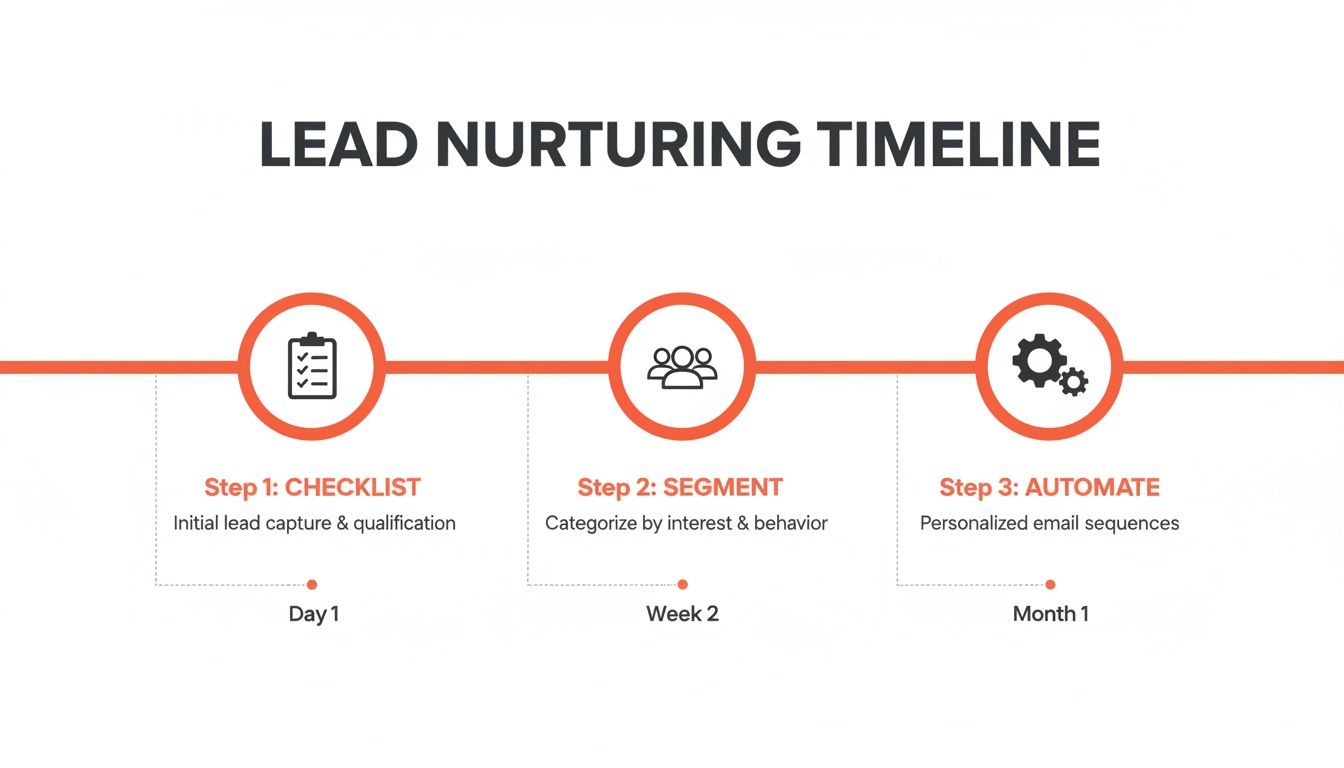
This process shows that solid lead nurturing is a structured system, not just a series of random, disconnected actions.
Month 1: Laying the Foundation
Your first 30 days are all about getting your core online presence nailed down and generating those first few digital leads. We're focusing on high-impact tasks that deliver the quickest wins and set you up for success down the road.
- Goal 1: Optimize Your Google Business Profile. Don't just fill it out—complete every single section. Add at least 15 high-quality photos (your headshot, local spots, past listings) and then ask five recent clients to leave a review.
- Goal 2: Launch a Small Ad Campaign. You don't need a huge budget. Start with just $10 per day on Facebook or Instagram. Promote your best current listing or a lead magnet to a tightly targeted local audience.
- Goal 3: Define Key Metrics. You can't improve what you don't measure. Start tracking Website Traffic (how many people visit your site) and Cost-Per-Lead (what each new contact costs you from ads). This gives you a baseline to measure your growth against.
Month 2: Building Authority and Systems
With your foundation in place, Month 2 is all about creating content that people actually want and setting up automated systems to handle new leads. This is where you start becoming the go-to local expert.
The goal isn't just to get leads; it's to build a system that converts them. Automation and valuable content work together to build trust on your behalf, even when you're busy with clients.
Tasks for Month 2:
- Publish Your First Neighborhood Guide. Pick one key area you serve and write an in-depth guide. Make it real—include your own photos, shout-outs to local businesses you love, and school information.
- Create a Simple Email Welcome Series. This doesn't have to be complicated. Just write a three-part email sequence for new leads. The first email delivers the lead magnet they signed up for, the second shares a genuinely helpful tip, and the third introduces a powerful client testimonial.
Month 3: Scaling and Refining
By now, you should have a steady trickle of traffic and new contacts coming in. Month 3 is focused on looking at your results and scaling what's working. You’ll use the data from your first two months to make much smarter decisions.
Your job is to double down on the channels giving you the best return. If those Facebook ads are bringing in low-cost seller leads, it’s time to increase your budget. If your neighborhood guide is getting a ton of traffic, write another one for a different area.
This cycle of testing, measuring, and refining is the absolute key to sustainable growth.
Common Questions, Answered
Jumping into digital marketing always brings up a few questions. Let's tackle some of the most common ones I hear from agents so you can move forward with a clear, confident plan.
How Much Should I Budget for Digital Marketing?
A solid starting point is to set aside 5-10% of your gross commission income. But if you're just getting started or watching every penny, don't sweat it. Your first move should be focusing on the free stuff that packs the biggest punch.
Get your Google Business Profile completely dialed in and make it a habit to ask every single client for a review. Once that machine is running, you can start putting a few hundred dollars a month into hyper-local social media ads. The trick is to track what's working and pour more money into the strategies that actually bring you quality leads.
I Have Limited Time. What Should I Do First?
If time is your tightest resource, your number one priority is your Google Business Profile. Period. It's the most powerful free tool you have for catching local buyers and sellers who are actively looking for an agent right now.
First, go through and fill out every single section—don't leave anything blank. Upload at least 10 sharp, professional photos. Second, and this is non-negotiable, ask every client for a review. Once that's done, pick one social media platform you can stick with and post consistently valuable stuff.
When you're stretched thin, you have to focus on the 20% of activities that drive 80% of your results. A polished Google profile and a steady stream of reviews are the fastest ways to show up where it counts.
Are Professional Photos Really Worth the Money?
Absolutely, one hundred percent. In today's market, your listing photos are your first showing. You get one chance to grab a buyer's attention, and they'll scroll right past a listing with dark, blurry, or just plain bad photos without a second thought.
Professional visuals aren't a luxury anymore; they're table stakes. It's just a fundamental part of competing effectively. The good news is that new tools are making this easier and more affordable than ever, letting you generate stunning photos, virtual staging, and other marketing materials from a simple video. There's no excuse not to make every property look its absolute best.
At Bounti Labs, we make it effortless to create stunning visuals for every listing. With just a single video, our AI assistant generates MLS-ready photos, virtual staging, and compelling property descriptions, helping you win more clients and close more deals. See how it works at https://www.bounti.ai.