

To generate listings in real estate consistently, you need more than just hustle. The best agents build a scalable system that marries proven prospecting techniques with smart technology. It’s about creating a predictable, repeatable process for targeting motivated sellers, reaching out across multiple channels, and winning them over with top-notch marketing.
This is a fundamental shift from sporadic, hope-based efforts to a reliable business operation.
Building Your Modern Listing Generation Engine

Forget the old playbook of random cold calls and the occasional postcard drop. The agents who are thriving today aren't just working harder—they're working smarter by building a dependable listing generation engine.
Think of it as a machine that transforms listing acquisition from a source of constant stress into a predictable part of your business. It’s designed to consistently produce seller leads, no matter which way the market is swinging.
The heart of this approach is integrating multiple channels. If you rely on just one source—like referrals or open houses—you're leaving your business vulnerable. A truly robust engine blends timeless prospecting with the efficiency of modern technology.
Before we dive deep, here's a quick overview of how the key pieces fit together.
Quick Guide to a Modern Listing Strategy
This table breaks down the core pillars of a system designed to create a consistent flow of new listings.
Each element supports the others, creating a system that turns contacts into contracts.
The Pillars of a Predictable System
A truly effective system isn’t built on a single tactic; it's constructed from several key components that all work in harmony. Each piece supports the others, creating a smooth path from that first "hello" to a signed listing agreement. This approach ensures no opportunity ever falls through the cracks.
Here’s what that looks like in practice:
- Targeted Prospecting: Stop casting a wide, generic net. Instead, identify specific segments of motivated sellers like FSBOs, expired listings, or even absentee owners.
- Multi-Channel Outreach: Engage prospects with a planned sequence of calls, emails, social media touches, and maybe even some high-quality direct mail. The goal is to stay visible without being annoying.
- Value-Driven Communication: Build trust long before you ever ask for their business. Provide genuinely helpful information, like hyper-local market reports or recent neighborhood sales data.
- Technology Integration: Use a CRM to track every single interaction and AI-powered tools to create stunning marketing assets that will blow potential sellers away.
A modern listing strategy isn’t about finding a single magic bullet. It’s about layering multiple, consistent actions over time to create an undeniable presence in your market.
Shifting from Reactive to Proactive
So many agents get trapped in a reactive mode, just waiting for leads to fall into their lap. This creates that dreaded feast-or-famine cycle that feels impossible to escape.
Building an engine means you are proactively creating your own opportunities and nurturing a pipeline of future sellers. You become the go-to expert in your area because people see you everywhere, always providing value.
The key is to systematize your efforts. Create templates for your emails, marketing materials, and outreach scripts. This not only saves a massive amount of time but also ensures every potential client gets the same professional, polished experience. This is how you move beyond just closing a handful of deals and start building a thriving, long-term business.
For a closer look at the digital side of things, check out our guide on digital marketing for real estate agents.
Finding and Connecting With Motivated Sellers
If you want to generate listings consistently, you have to stop chasing everyone. The real key is to start focusing on sellers who have a clear, compelling reason to make a move.
Generic prospecting is a brutal numbers game with a terrible success rate. Strategic prospecting, on the other hand, is about identifying specific types of sellers who are already primed to act. Then, you simply tailor your approach to their unique situation.
This means looking beyond your immediate circle and actively digging for data-driven opportunities. The goal here is to spot the motivation signals before your competition does, turning raw information into real, productive conversations.
Identifying High-Intent Seller Segments
Certain groups of property owners are just flat-out more likely to sell. When you focus your energy on these segments, you make your prospecting time incredibly efficient. It's the difference between shouting into a crowd and having a quiet, direct conversation.
Here are the primary seller archetypes I always keep an eye on:
- For Sale By Owner (FSBOs): These sellers have literally raised their hand and announced their intention to sell. The thing is, many of them underestimate how complex the process is and get frustrated fast. Roughly 90% of FSBOs eventually list with an agent, which makes them a golden opportunity.
- Expired and Withdrawn Listings: A property that failed to sell is a huge pain point for the owner. They're often disappointed with their previous agent and are desperate for a new strategy. Your job is to walk in and show them exactly what you'll do differently.
- Absentee Owners: These are landlords or people who own property they don't live in. They might be tired of managing a rental, dealing with tenants, or just ready to cash out their investment, especially in a hot market.
- Probate Leads: When a property owner passes away, their heirs often need to sell the property to settle the estate. This is obviously a sensitive situation that requires a delicate, empathetic approach. You're not just an agent; you're a problem-solver during a difficult time.
Success in listing generation isn't just about finding leads; it's about finding the right leads. Focusing on motivated sellers with a clear need is the fastest way to build a robust pipeline.
Uncovering Motivation with Data
Once you’ve picked your target segments, the next move is using data to pinpoint the most promising prospects within those groups. You’re looking for signs of a life change or a financial reason to sell. Public records, local demographic info, and specialized data services can give you some incredible clues.
Think about it this way: an agent in a competitive suburban market could analyze property records to find homeowners who have been in a big four-bedroom house for over 25 years and whose kids just graduated from the local high school. These are classic empty-nesters who are perfect candidates for downsizing.
This data-driven approach lets you craft a message that’s super personal and relevant. Instead of a generic "Thinking of selling?" postcard, your outreach can speak directly to their potential situation. Something like, "Many homeowners in our community are finding that now is the perfect time to capitalize on their equity and move into a home that better fits their current lifestyle."
Crafting Your Personalized Outreach
With your segmented list ready to go, your outreach can't be a one-and-done deal. A single cold call is easy to ignore. But a strategic sequence of touches across different channels? That's much harder to miss. This could be a mix of calls, personalized emails, direct mail, and even a well-placed social media message.
When you're actively hunting for motivated sellers, using technology to work smarter is a game-changer. For example, learning about effective voicemail drops for real estate investors and agents can help you deliver a consistent message at scale without being glued to your phone all day.
The secret is to lead with value, not a sales pitch. For an expired listing, you might send a quick analysis of why their home might not have sold, pointing to photos or marketing copy that could be stronger. For an absentee owner, you could offer a free rental analysis or a report on recent investment property sales in their area.
This positions you as a helpful expert and builds trust long before you ever ask for the listing.
Mastering Your Outreach and Follow-Up System
Pinpointing a potential seller is just the start. The real work—and honestly, where most agents either win or lose the listing—is in the follow-up. It's the consistent, value-driven communication that turns a name on a list into a signed agreement.
Too many agents jump the gun and ask for the business way too early. A killer outreach system is built on patience. It's about establishing yourself as a trusted advisor long before you ever slide a listing agreement across the table.
This means having a multi-touch plan that smartly blends calls, emails, social media, and even a little old-school direct mail. The goal is to stay top-of-mind without being annoying, making every single interaction a deliberate step forward.
The simple flow below nails the foundation of a modern client acquisition process.
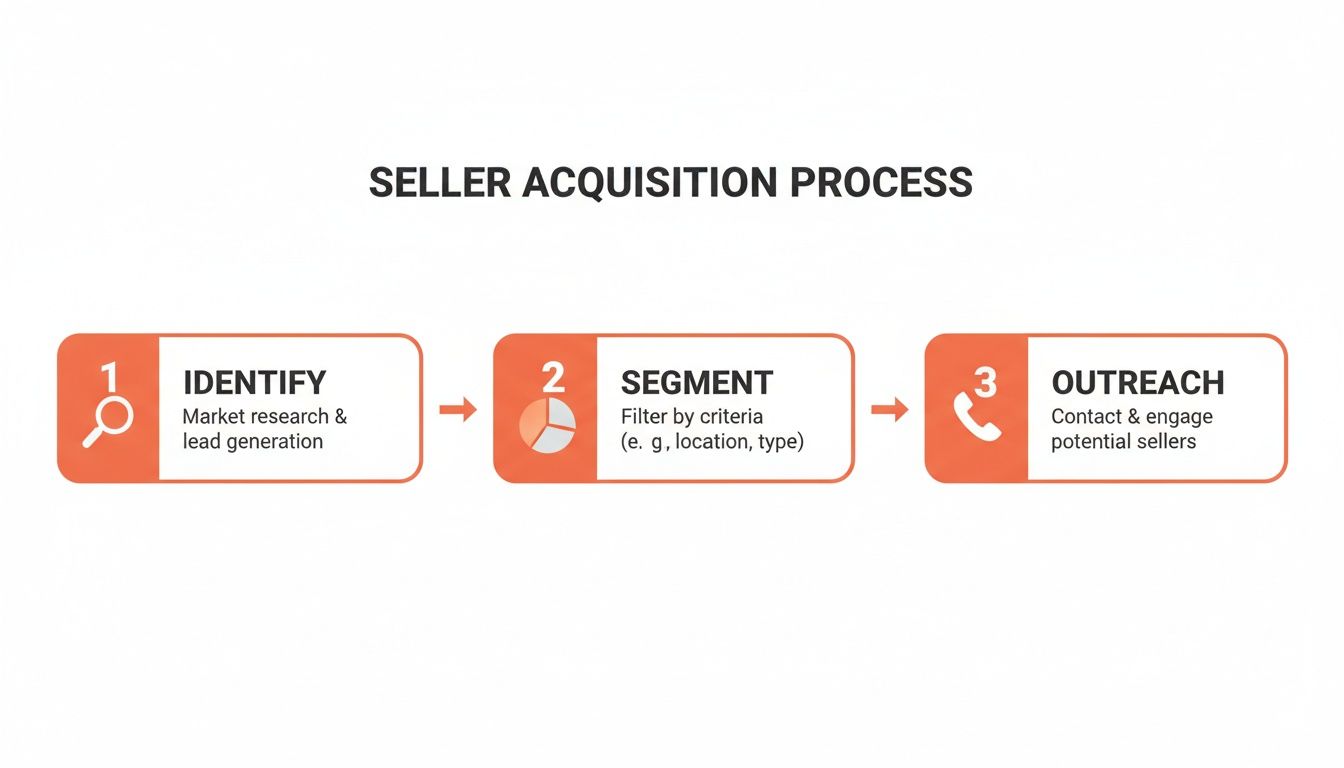
This visual just reinforces that effective outreach isn't one single action. It's a system that moves from broad identification to targeted, personal conversations.
Designing Your Multi-Touch Cadence
A multi-touch cadence is just a fancy term for a pre-planned sequence of outreach over a set period. The objective is simple: make meaningful contact and build some rapport. For a new seller lead, a solid cadence might span 4-6 weeks and include 8-12 touches.
This isn't about spam. Each touchpoint needs to feel different and actually provide some value.
Here’s a sample framework you can steal and adapt:
- Day 1: Kick things off with a phone call and a follow-up email. The call is just a quick intro, and the email should give them something useful, like a market report for their specific zip code.
- Day 3: Send a simple text. Something casual like, "Hi [Name], just wanted to make sure you got the market report I sent over. Let me know if you have any questions!"
- Day 7: Drop a high-quality piece of mail. This could be a professionally designed postcard showing recent neighborhood sales or even a handwritten note.
- Day 14: Connect on social media. A simple LinkedIn request or an Instagram follow is a low-pressure way to stay on their radar.
- Day 21: Time for another call. This time, you're not just checking in; you're asking smart questions based on the info you've already sent them.
The key to a winning follow-up system is persistence without pressure. When you lead with value at every step, you stop being a salesperson and start being a resource. That’s how you consistently land new listings.
Customizing Scripts for Different Sellers
A generic script will get you generic results. The top agents I know tailor their approach to the seller's specific situation and pain points. Your conversation with an expired listing should sound completely different from your chat with a potential downsizer.
Let's walk through a real-world scenario.
You're calling the owner of an expired listing. They're probably frustrated with their last agent and skeptical of you. The weak approach is asking, "Are you still interested in selling your home?" Yawn.
A powerful approach speaks directly to their frustration and offers a fresh solution. You might say, "I saw your home recently came off the market. I specialize in marketing strategies for properties that didn't sell the first time, and I have a few specific ideas on how a different approach to photography and online promotion could attract the right buyers."
This script is money. It does three things instantly:
- Acknowledges their pain point right off the bat.
- Positions you as a specialist, not just another agent.
- Offers specific value ("ideas on photography and online promotion") instead of just asking for the business.
Leveraging a CRM to Systematize Follow-Up
Look, trying to manage this whole process with sticky notes or a spreadsheet is a recipe for disaster. If you're serious about building a scalable listing machine, a Customer Relationship Management (CRM) system is non-negotiable.
Your CRM is your second brain. It tracks every call, email, and meeting, so nothing falls through the cracks. You can set up automated reminders for every step in your cadence, ensuring no lead gets left behind. It lets you see a lead's entire history in a second, so you can pick up every conversation exactly where you left off. For agents wanting to take this a step further, exploring different types of real estate marketing automation software can be a total game-changer.
Ultimately, a well-used CRM turns your follow-up from a chaotic mess into a predictable, proactive system. That consistency is what separates the top producers from everyone else, guaranteeing you a steady pipeline of opportunities month after month.
Winning Listings with a Tech-Forward Presentation

This is it—the moment where all your prospecting and follow-up pay off. But let’s be honest, in a crowded market, the standard listing presentation feels tired. Walking in with just a CMA and a promise to "market the property aggressively" isn't going to cut it anymore. Sellers have heard that same pitch from every other agent.
To actually stand out and win the business, you have to shift from telling sellers what you'll do to showing them. A tech-forward presentation makes your value tangible from the first handshake, proving you bring a superior marketing game to the table. This is how you win listings, even when you're up against agents with decades of experience.
Go Beyond Promises with Pre-Built Assets
Imagine this: instead of just a folder full of papers, you walk into a listing appointment and pull out a tablet showcasing the seller's home… already transformed. That’s the power of creating "spec" (speculative) marketing assets before you even sit down at their kitchen table.
You aren't just talking about professional staging; you’re showing them their cluttered living room as a clean, modern, virtually staged space. You’re presenting their dated kitchen restyled with contemporary finishes. This isn't just a gimmick. It’s a powerful psychological tool that helps sellers visualize their property’s full potential—and your unique ability to unlock it.
Tools like Bounti make this surprisingly easy. You can take a quick video walkthrough and almost instantly generate:
- Virtually Staged Photos: Turn empty or outdated rooms into inviting spaces that connect with today's buyers.
- Decluttered Visuals: Digitally remove personal items and clutter to create a clean, market-ready look, all without the seller lifting a finger.
- AI-Generated Property Descriptions: Craft compelling, MLS-ready descriptions that highlight the home's best features in seconds.
Bringing these assets to the meeting builds instant credibility. You've already invested time and effort in their property before they've signed anything, demonstrating a proactive approach that other agents can only promise.
Why Professional Visuals Are Non-Negotiable
In today's market, high-quality visuals aren't a luxury; they're the bare minimum. A staggering 97% of homebuyers use the internet in their property search, which means your listing's digital storefront is its most important feature.
Think about it. Homes with professional drone photography sell up to 68% faster than those without. Why? Because superior imagery—from sweeping aerial shots to perfectly styled interiors—grabs attention and helps buyers form an emotional connection before they even step inside.
The modern listing presentation isn't a pitch; it's a preview of the high-caliber marketing you'll deploy. When you show sellers a vision of their home already looking its absolute best, you make their choice of agent incredibly simple.
This is where AI-powered tools give you a massive competitive advantage. Let’s say you’re trying to win a listing for a suburban home with a 90s-era kitchen and kids' rooms that are… well, lived in. With a tool like Bounti, you can upload a simple video, automatically declutter the rooms, restyle the kitchen into a modern showpiece, and generate descriptions that pop. It's about delivering a level of marketing sophistication that wins more listings, plain and simple.
Structuring Your Tech-Powered Pitch
Weaving these visuals into your presentation is key. Don't just lead with the flashy images; you want to build up to the reveal for maximum impact.
Here's a flow that works wonders:
- Start with the Market: Kick things off with your CMA. This grounds the conversation in data and establishes the logical foundation for your pricing strategy.
- Outline Your Marketing Plan: Next, detail your comprehensive strategy—social media campaigns, email blasts, the open house schedule. This shows the sheer breadth of your efforts.
- The Visual Reveal: This is your "wow" moment. You can transition by saying something like, "I've outlined what I plan to do, but I wanted to show you what your home could look like to potential buyers right now." Then, present the virtually staged and decluttered images.
- Connect to Results: Bring it all home by explaining how this level of marketing leads directly to more showings, higher offers, and a faster sale. You’re connecting your tech-forward approach to their ultimate goal.
This method transforms your meeting from a conversation about commissions into a collaborative strategy session. To really nail this final step, check out our complete guide on how to create a winning real estate listing presentation. By proving your value upfront, you move beyond promises and start securing more listings.
Building Scalable Systems for Predictable Growth
Winning a single listing is an event. Consistently generating them is a business.
The real leap, the one that takes you from sporadic success to predictable growth, doesn't come from just working harder. It comes from building smart systems. This is the final piece of the puzzle—turning your successful actions into a repeatable engine that runs smoothly, whether you're at the wheel or not.
One-off efforts are a recipe for the feast-or-famine cycle that burns out even the most dedicated agents. A scalable system, on the other hand, ensures that every bit of energy you invest today continues to pay dividends tomorrow. It’s about creating a true listing machine, not just chasing the next deal.
Creating Your Reusable Asset Library
The first step toward true scale is to stop reinventing the wheel with every new prospect. Think about it: every successful email you write, every compelling flyer you design, and every presentation slide that gets a seller nodding their head should be saved, refined, and turned into a template. This becomes your personal asset library.
This library does two critical things: it ensures your brand looks sharp and consistent every single time, and it saves you an incredible amount of time. Instead of starting from a blank page, you begin each task 80% of the way done.
Your asset library should include things like:
- Email Templates: Have ready-to-go versions for your initial outreach to FSBOs, expireds, and other lead types. You'll also want follow-up sequences and post-appointment thank-you notes.
- Marketing Materials: Keep templates for property flyers, social media graphics, and those crucial "just listed" or "just sold" announcements.
- Presentation Decks: Build a master listing presentation that you can quickly customize with a fresh CMA and property-specific marketing assets.
Your goal is to systematize excellence. By turning your best work into reusable templates, you make sure every potential client gets the same high-quality, professional experience, every single time.
Strategic Delegation and Outsourcing
You cannot scale if you remain the bottleneck in your own business. It's a hard truth. So many of the repetitive, time-consuming tasks involved in drumming up listings can be delegated, freeing you up for the high-value, client-facing activities that only you can do.
Take a hard look at the tasks that eat up your prospecting time but don't necessarily require your real estate license or unique expertise. These are prime candidates for outsourcing to a virtual assistant (VA) or a junior team member.
Common tasks to delegate include:
- Data Management: Pulling property records, cleaning up lead lists, and keeping your CRM updated with new contacts and interactions.
- Initial Prospecting: A well-trained VA can handle initial cold calls or send out the first wave of emails to qualify leads before they ever land on your plate.
- Marketing Execution: Scheduling social media posts, getting direct mail campaigns ready to go, and coordinating with photographers or stagers.
By strategically offloading these responsibilities, you shift from being an operator in your business to an executive working on your business. This is the fundamental mindset shift required for long-term, predictable growth.
Mapping Your Listing Generation Workflow
A workflow is just a map of your entire process, from the moment you spot a potential lead to the day they sign on the dotted line. Documenting this journey is critical. It instantly reveals where you're wasting time, highlights opportunities for automation, and creates a clear playbook for your team to follow.
A simplified workflow might look something like this:
- Lead ID: A VA scours Zillow and the MLS for new FSBO and expired listings daily, adding them to a dedicated list in the CRM.
- Initial Outreach: The system automatically kicks off a pre-written, 8-touch email and text message campaign over the first two weeks.
- Qualification: The second a lead responds or clicks a link, a notification gets sent straight to you for a personal follow-up call.
- Nurturing: If the lead isn't quite ready, they're moved to a long-term monthly newsletter campaign that provides market updates and genuinely useful content.
- Appointment Set: When a meeting is booked, another automated workflow sends appointment reminders and a pre-listing package with your best marketing examples.
- Presentation & Signature: You step in to conduct the listing presentation, using your pre-built deck and marketing assets to win the business.
This documented process ensures nothing falls through the cracks. It transforms a chaotic series of to-dos into a smooth, efficient assembly line for generating listings. This is the system that allows you to step back, manage the process, and watch your business grow—predictably.
Got Questions? We’ve Got Answers.
Even the sharpest listing generation plan runs into real-world questions. When you're out there talking to homeowners, things get complicated. Let's walk through some of the most common sticking points agents hit and how you can navigate them like a pro.
How Long Should a Follow-Up Cadence Be?
There's no single magic number, but the goal is to be persistent without being a pest. A great place to start is a 12-touch plan spread over 4-6 weeks. The key is mixing up your communication channels to stay on their radar in different ways.
A simple, effective sequence might look something like this:
- Day 1: Call them. Follow up immediately with an email that includes a helpful market report.
- Day 3: Send a quick, casual text. "Hey, just wanted to make sure you got the market report I sent over. Any questions?"
- Day 7: Drop something tangible in the mail. A high-quality neighborhood sales map works wonders.
- Day 14: Connect on a professional social platform like LinkedIn.
- Day 21: Time for another call to follow up and see what they’re thinking.
Notice the theme? You're providing value at every single touchpoint, not just begging for their business. Once this initial push is over, you can slide them into a monthly newsletter to keep the relationship warm until they're ready to make a move.
How to Handle the "Not Ready to Sell" Objection
First off, this is an opportunity, not a rejection. The absolute worst thing you can do is say "Okay, thanks!" and walk away. Instead, agree with their timing and smoothly pivot to being their go-to resource.
Try a response that feels natural and helpful, like this: "I completely understand. Timing is everything in real estate. Would it be helpful if I just kept you in the loop with a quarterly market analysis for your neighborhood? That way, when you are ready, you'll have all the right information to make a great decision."
This simple shift instantly changes the dynamic. You're no longer a salesperson trying to get a signature; you're a trusted expert offering help with no strings attached.
From there, it's all about the follow-through. Pop a reminder in your CRM to send those quarterly updates. A huge number of these "not yet" leads will turn into clients within 6 to 18 months, and your patient, value-first approach is what will make them call you when the time is right.
Is Investing in AI Tools Worth It for New Agents?
Absolutely. In fact, for agents with fewer listings, it might be more important. When you only have a few shots to take each year, every listing presentation and marketing campaign has to be a home run.
AI tools are surprisingly affordable and give a solo agent the power to create marketing materials that compete with the biggest teams in town. Think about it: instead of dropping thousands on physical staging for one house, you can generate unlimited virtual stagings, declutter messy rooms, and create stunning photos for a tiny fraction of the cost.
This doesn't just help you sell the property faster and for more money. It becomes a powerful part of your portfolio. The next time you walk into a listing presentation, you can show a potential seller tangible proof of your superior marketing, making it that much easier to win their business.
At Bounti Labs, we believe every property deserves to look its best. With a single video, Bounti generates everything you need—from stunning photos and virtual staging to compelling property descriptions—in seconds. See how you can win more listings by visiting https://www.bounti.ai.